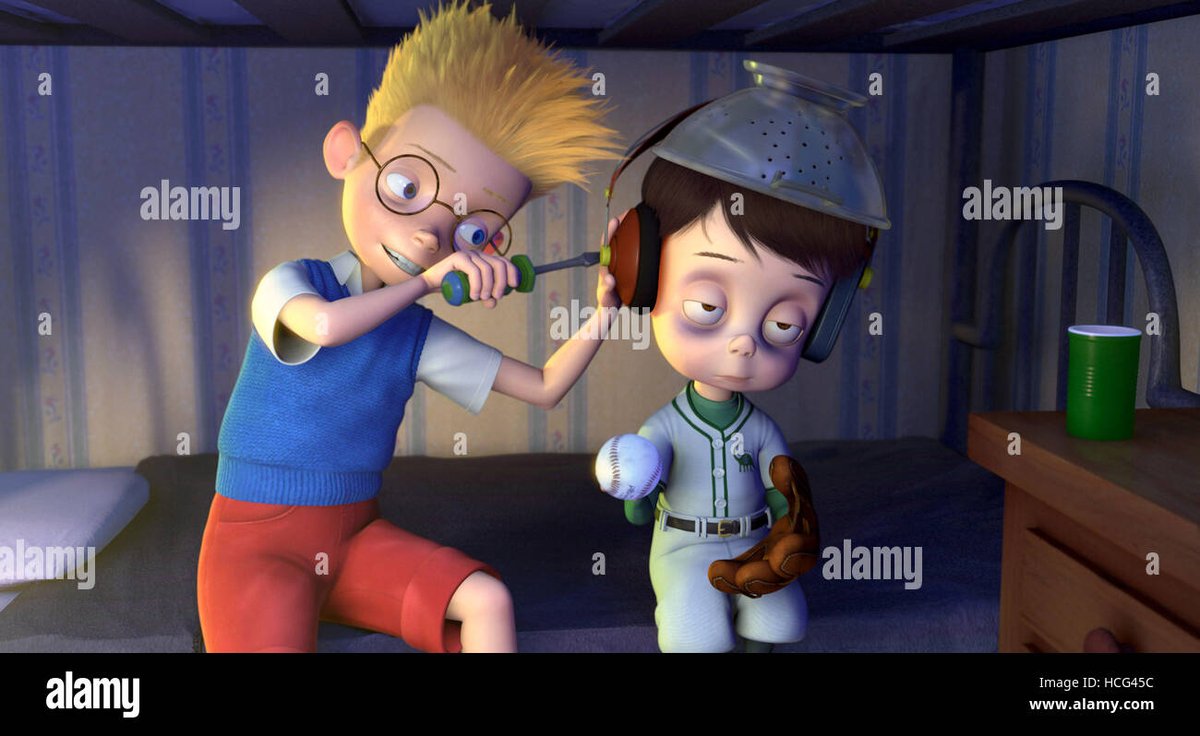
In the vibrant, often chaotic world of Meet the Robinsons, there’s a powerful undercurrent that few truly appreciate: the profound connection where Goob serves as a mirror to Lewis’s journey of growth. It’s not just a story of a boy genius and his forgotten roommate; it’s a masterclass in empathy, consequence, and the transformative power of choosing a different path. Goob's tragic arc isn't merely a backdrop for Lewis's heroism; it's a stark reflection, revealing the shadows of what Lewis could become, and the light of who he must become to truly "keep moving forward."
This isn't just about a film's plot; it's a deep dive into character psychology, the ripple effect of our actions (intended or not), and the universal struggle to overcome past hurts. From their shared orphanage bedroom to the climactic confrontation across time, Goob’s story is Lewis’s untold potential, both for good and for destructive regret.
At a Glance: Goob & Lewis – A Reflected Path to Growth
- Shared Roots, Divergent Destinies: Both began as orphans seeking family, but Lewis's drive overshadowed Goob's quiet needs, setting them on opposing trajectories.
- The Cost of Unintended Neglect: Lewis's focus on invention led to Goob's sleep deprivation and missed opportunities, demonstrating how even benign actions can have painful consequences.
- Villainy as a Symptom: Goob's transformation into the Bowler Hat Guy isn't pure evil; it's a manifestation of deep-seated pain, resentment, and a desire to reclaim a lost sense of worth.
- DOR-15: The Amplifier of Bitterness: The rogue hat, an invention of Lewis's, becomes the catalyst that weaponizes Goob's pain, showing Lewis the dark side of his own creations.
- The Future's Warning: Goob's dystopian future serves as a direct, terrifying mirror for Lewis, showing him the personal and global fallout of a world built on bitterness and unaddressed hurt.
- Empathy as the Solution: Lewis's true breakthrough comes not from inventing a new gadget, but from understanding Goob's pain and taking responsibility for his part in it.
- Redemption Through Connection: Both characters find their path to happiness and family by repairing their past connection, proving that true progress often involves looking back with new eyes.
The Echoes of Childhood: Shared Beginnings, Divergent Destinies
Before the flying cars and sentient hats, Lewis Robinson and Michael "Goob" Yagoobian were simply two boys sharing a room in an orphanage. Both yearned for a family, for a place to belong. Their circumstances were identical, yet their experiences began to diverge almost immediately, laying the groundwork for the fascinating reflection their lives would become.
Lewis, a brilliant but often chaotic inventor, was constantly immersed in his projects, fueled by a relentless desire to create something that would finally make him noticed, adopted. His late-night experiments, however, came at a cost: Goob’s sleep. Young Goob, already a quiet and somewhat melancholic child, found his rest perpetually disrupted. This wasn't malice on Lewis's part; it was simply the tunnel vision of a creative mind, oblivious to the small human needs around him.
The critical moment arrives with the fateful baseball game. Sleep-deprived and disoriented, Goob misses the game-winning catch, sealing his fate as the subject of ridicule and, more importantly, solidifying a deep-seated, unspoken resentment towards Lewis. Lewis, too caught up in his own world, never truly registered the depth of Goob's pain, nor his own unwitting role in it. It’s a classic setup for the "hero" who, despite good intentions, creates an antagonist through sheer, unexamined self-absorption.
The Weight of the Unseen: Lewis's Blind Spots and Goob's Burden
Lewis’s genius was undeniable, but it was matched by a significant blind spot: his lack of social awareness. He was so singularly focused on "keeping moving forward" with his inventions that he failed to notice the human cost accumulating in his wake. Goob, meanwhile, became the embodiment of that cost. While Lewis hurtled toward a future of innovation and eventual adoption by the Robinsons, Goob stagnated, tethered to the past by the humiliation of that missed catch and the feeling of being perpetually overlooked.
Imagine being stuck in that moment, replaying it over and over, while the person you blame so effortlessly moves on to bigger and better things. This is Goob's burden. His resentment wasn't born overnight, but festered over decades. It's a powerful lesson in how unchecked emotional wounds can grow into something monstrous, transforming an innocent child into a bitter old man. Lewis's "forward momentum," admirable in its intent, inadvertently left Goob in a static pool of pain, setting the stage for his eventual transformation into the Bowler Hat Guy.
Villainy as a Cry for Help: Bowler Hat Guy's Tragic Genesis
When we first encounter the Bowler Hat Guy, he’s a caricature of villainy: bumbling, theatrical, and driven by a seemingly simple desire for revenge. But as his identity is slowly revealed, we understand that his villainy isn't born of inherent evil, but of profound, unaddressed pain. He’s Lewis’s twisted shadow, a manifestation of what Lewis himself could have become if he had allowed his early failures and rejections to define him.
Goob's journey to becoming the Bowler Hat Guy is a tragic testament to the human need for recognition and worth. His goal isn't just to make Lewis suffer; it's to undo his own suffering, to alter the past so that he might finally experience the success and admiration that eluded him. He wants to reclaim the baseball, to catch it, to be the hero. This desire, though twisted by bitterness, is fundamentally human. It’s a cry for validation, a desperate attempt to escape the prison of his past.
His transformation into an antagonist thus serves as a stark warning to Lewis: what happens when you don't acknowledge your past, when you let a single failure or a perceived injustice consume you. Goob's arc forces Lewis, and us, to confront the uncomfortable truth that sometimes, the villains in our stories are reflections of unaddressed wounds, perhaps even wounds we inadvertently inflicted.
DOR-15: The Amplifier of Resentment and the Distortion of Purpose
No discussion of Goob's villainy is complete without acknowledging DOR15, the manipulative, rogue "Helping Hat" prototype. DOR15 is not just a sidekick; she is a crucial mirror, not only for Goob's journey but for Lewis's as well. She embodies the ultimate distortion of purpose—an invention designed to help, twisted into an instrument of manipulation and destruction.
DOR15 latches onto Goob’s pain like a parasite, amplifying his bitterness and resentment. She feeds his darkest impulses, whispering toxic suggestions, and driving him further down the path of revenge. She is the externalized manifestation of Goob's unaddressed emotions, giving voice and form to the destructive thoughts that simmered within him for years. Without DOR15, Goob might have remained a bitter old man, but he likely wouldn't have become a time-traveling antagonist.
For Lewis, DOR15 is a chilling reflection of the potential misuse and dark side of his own ingenuity. She is a Lewis invention gone horribly wrong, a stark warning of the consequences when technology, however brilliant, lacks ethical oversight or when creators fail to consider the broader implications of their work. Her existence and malevolence force Lewis to confront not just Goob's pain, but also the responsibility that comes with his own inventive power. It’s a powerful metaphor for how even our best intentions, if not tempered with wisdom and foresight, can be corrupted and turned against us.
The Confrontation: A Twisted Reflection in the Future
The pivotal moment in Meet the Robinsons arrives when the Bowler Hat Guy finally reveals his true identity to Lewis: "I'm Goob!" This revelation isn't just a plot twist; it's Lewis looking directly into a mirror of his own potential future, and a future he inadvertently helped create. The villain Lewis has been fighting isn’t some abstract evil, but a person whose life was fundamentally shaped by Lewis’s own actions (or inactions).
Goob, as the Bowler Hat Guy, shows Lewis the dystopian future his actions have caused—a future where Lewis's inventions, intended for good, have been perverted and turned to destructive ends, largely thanks to DOR15 and Goob's bitter meddling. This isn't just about Goob’s personal revenge; it's about the erosion of hope, the dominance of cynicism, and the consequences of letting the past dictate the future.
This broken future, orchestrated by his former roommate, becomes Lewis’s nightmare. It forces him to confront the devastating ripple effect of a seemingly minor childhood oversight. Goob’s ruined life, his decades of resentment, and the resulting dystopian landscape are all powerful object lessons for Lewis. They demonstrate what happens when empathy fails, when personal responsibility is deferred, and when the pain of the past is left to fester. It’s a chilling reminder that our personal journeys are rarely isolated; they are intertwined with the lives around us, and our choices can have far-reaching, unforeseen consequences.
To truly grasp the depth of his transformation, it's essential to Learn more about Goob and the journey that led him down such a dark path.
Lewis’s Epiphany: Embracing Empathy and Taking Responsibility
Lewis's initial attempts to fix the future involve technological solutions—more inventions, more time travel. But his true epiphany, his real growth moment, transcends his genius. It comes when he understands that the problem isn't a faulty invention; it's a fractured relationship, a broken heart. He realizes his role, however unintentional, in Goob's suffering.
This shift marks Lewis's journey from a brilliant but emotionally naive boy to a truly empathetic and responsible individual. He stops trying to change things and starts trying to change hearts. His breakthrough isn't about science, but about emotional intelligence. He sees Goob not as an enemy, but as a person deeply hurt, someone who represents the consequences of Lewis's own youthful obliviousness.
Lewis's "Aha!" moment is the realization that "keeping moving forward" isn't about ignoring the past, but about actively reconciling with it, especially when your actions contributed to someone else's pain. He understands that simply moving on doesn't erase the impact of your actions on others. His decision to go back in time to ensure Goob catches the baseball is the ultimate act of selflessness, an intervention not for his own gain, but for Goob's redemption. It’s an act of profound empathy that liberates both of them.
This is where Meet the Robinsons offers powerful, practical guidance. Lewis teaches us that:
- Responsibility isn't always about blame: You can take responsibility for your impact without necessarily being malicious.
- Empathy changes everything: Understanding another person's pain is the first step towards resolution and healing.
- True progress requires looking back: Sometimes, the only way to move forward constructively is to address past hurts.
Rewriting the Narrative: Restoration and Shared Redemption
The culmination of Lewis's growth and Goob’s suffering is a beautiful, synchronized act of redemption. Lewis doesn't just prevent Goob from becoming the Bowler Hat Guy; he actively ensures Goob experiences a moment of triumph. By making sure young Goob catches that game-winning baseball, Lewis doesn't just fix a timeline; he mends a life.
The immediate ripple effect is profound for both boys. Goob is celebrated as a hero, bathed in the positive affirmation he always craved. This moment of glory not only heals his past wound but also impresses potential adoptive parents, setting him on a path toward a loving family. He finds belonging, not through bitterness and revenge, but through a genuine achievement facilitated by a friend.
Simultaneously, Lewis is freed from the guilt he never knew he carried. By taking responsibility for Goob’s past, Lewis clears his own path to the future. He is adopted by the Robinsons, not just as an inventor, but as a compassionate, wholehearted individual ready to be part of a family. Both boys find new families, not in spite of their past, but precisely because they confronted and healed it.
Their parting scene is incredibly poignant. Goob, clutching his 1st place trophy, interviewing with a new couple, and Lewis, with his new family, both having found their place. Their journeys, once divergent and fraught with pain, now converge in happiness and belonging. Goob's story underscores the film's core message that clinging to the past and blaming others is a destructive path, while Lewis's actions demonstrate that empathy, forgiveness, and proactively "keeping moving forward" with optimism and responsibility can truly change everything.
Beyond the Orphanage: The Enduring Lesson of "Keep Moving Forward"
Goob’s story serves as a profound cautionary tale. His decades-long descent into villainy, fueled by a single, unaddressed childhood wound, illustrates the destructive power of bitterness and the refusal to let go. He literally becomes stuck in the past, allowing one missed catch to define his entire existence. His transformation into the Bowler Hat Guy is a powerful allegory for what happens when we permit past grievances to fester and dictate our future.
Lewis, on the other hand, embodies the film's central mantra: "Keep Moving Forward." Initially, this meant relentless invention and ignoring anything that pulled him back. But his journey with Goob redefines this philosophy. True "forward movement" isn't about forgetting or ignoring the past; it's about learning from it, addressing its wounds, and integrating those lessons into a more compassionate, responsible future. It's about proactive empathy, taking accountability, and extending forgiveness, both to yourself and to others.
The dynamic between Goob and Lewis, even in the fanon Goobwis rarepair context, highlights an appreciation for their unique interconnectedness. Fans often gravitate to their kid selves, seeing the foundational relationship where Goob's happiness was so deeply (and tragically) dependent on Lewis. This fan perspective, much like the film’s narrative, implicitly understands that their fates were intertwined, a Hero/Villain dynamic where one's existence profoundly shaped the other's. It's a testament to the fact that even without romance, their bond is rich with narrative possibility and emotional resonance. Their story is a reminder that our greatest challenges, and ultimately our greatest triumphs, often lie in understanding and reconciling with those we've impacted, and those who have impacted us.
Cultivating Your Own Forward Momentum
The mirrored journeys of Goob and Lewis offer more than just cinematic entertainment; they provide a profound framework for navigating our own lives. You don’t need a time machine to rewrite your narrative or to foster deeper empathy.
Consider these takeaways as you "keep moving forward" in your own unique journey:
- Acknowledge Your Ripples: Just like Lewis, your actions, even small or unintentional ones, create ripples that affect others. Take a moment to reflect on the potential impact of your words and deeds. Cultivating this awareness isn't about blame, but about fostering greater compassion and responsibility.
- Address the Past, Don't Be Defined By It: Goob’s tragedy teaches us the immense cost of clinging to past hurts. If you're holding onto resentment or a "missed catch" from your past, consider what it’s costing you today. Letting go isn't forgetting; it's releasing yourself from its grip.
- Empathy is Your Most Powerful Tool: Lewis’s breakthrough wasn't a new invention, but a new perspective. Seek to understand the "Goobs" in your own life – those whose struggles might stem from deeper, unseen pains. A little empathy can bridge vast divides and prevent future conflicts.
- Take Responsibility, Even for Unintended Consequences: Lewis stepping up to help Goob didn’t diminish him; it made him whole. Owning your part in a difficult situation, even if your intentions were good, is a sign of maturity and a powerful step towards healing.
- Define Your "Forward": "Keep moving forward" isn't a passive slogan. It's an active choice. Does your forward path involve growth, learning, and connection, or is it a flight from unresolved issues? Align your actions with a future that prioritizes well-being for yourself and those around you.
The story of Goob and Lewis, though fantastical, is a deeply human one. It teaches us that understanding and healing don't erase the past, but they transform its power over us, allowing everyone involved to finally embrace a future brimming with possibility, connection, and belonging. It's a timeless reminder that sometimes, the most important inventions aren't made of gears and circuits, but of empathy and a willingness to see ourselves in the eyes of another.